Keeping Farm Kids Safe Starts With Solving the Rural Childcare Gap

Rural America is a childcare desert. For farming parents, care is limited and expensive, but without it, children face dangers on the farm.
By Lisa Foust Prater Published on October 6, 2026

Don’t take your kids in the tractor. Keep them away from the livestock. Never allow extra riders on the ATV.
These are the guidelines offered by many safety experts. While statistics back those statements, rural sociologist Florence Becot said her response is: “These messages are often not realistic for farm parents who are struggling — they need to work on the farm. Childcare is not available, it takes 40 minutes to get there, it’s not open when you need it, it’s really expensive, or it’s all of these things together. People will not take the advice seriously, because you don’t understand the reality of their situation.”
Other realities are that 33 children in the U.S. are seriously injured in agriculture-related incidents each day, and a child dies on a farm every three days, according to the National Children’s Center for Rural and Agricultural Health and Safety, which is funded by the Centers for Disease Control and Prevention. Some incidents occur while children are doing farmwork, but 60% of serious injuries involve nonworking children, the agency reported.
Linda Emanuel is an agricultural health liaison with the AgriSafe Network, a nonprofit focusing on agricultural occupational health and safety education. She is also a registered nurse and part of a multigeneration family farm near North Bend, Nebraska, 50 miles northwest of Omaha. Although safety is her primary message, she agrees there has to be a better way to talk to parents.
“They sometimes feel like they’re being threatened when questions are asked,” she said. “We need to find a way to collaborate with these parents to find a solution that keeps their kids safe, which is what we all want.”
RELATED: Choosing Age-Appropriate Chores
Farm Families Speak
Becot, an agricultural safety and health associate professor at Pennsylvania State University, is the principal investigator for a National Farm Medicine Center and Ohio State University study linking childcare to children’s safety on farms.
The 2023 study surveyed 860 farm and ranch families in 47 states, 186 of whom had children under 18. The research hit home for Becot, who grew up in rural France, with family ties to farming and whose mother provided in-home childcare, including to farm families. “The goal of this project was to debunk myths and understand the day-to-day realities of farm families,” she said.
One myth is all farmers are surrounded by extended family who can watch children at a moment’s notice. While that’s true for some families, Becot said: “Social networks and social structures in rural areas have changed a lot. We used to have more support available to help raise the children.”
We heard some resentment from women who said: ‘When I go work at the hospital, I don’t bring my kids. Why am I expected to have them with me when I’m running giant pieces of equipment?— Florence Becot
She said some parents told her their children’s grandmothers are still working off the farm to provide health insurance and the grandfathers are still actively farming. Other parents expressed distrust in their parents or in-laws, for reasons including cognitive decline.
“Another group of folks said they moved to an area where they could afford farmland but that meant leaving their families and social support behind,” Becot said. “One mother told me, ‘It takes a village to raise children, and we don’t have a village.’ This feeling of isolation is very different from the idea of multiple generations and a bunch of cousins to help.”
Emanuel said this study brought forward the underappreciated role of women on the farm. “Folks outside of ag don’t think about the added stress of finding care for kids when there’s work to be done and how that can lead to parents taking some dangerous shortcuts,” she said.
RELATED: Avoid Deadly Mistakes With ATVs
Mixed Methods
According to Becot, the study showed more than three-fourths of farm families experienced childcare challenges, largely due to cost and availability. “This means they often must cobble together multiple paid and unpaid childcare options,” she said.
For example, while a mother works in town, she might leave kids with a relative, at an in-home daycare, or at a childcare center. During especially busy seasons, she may organize a childcare swap with another mom or hire a local teenager to babysit. For everyday chores, she might leave them with an older child or, in many cases, take them with her.
“We heard some resentment from women who said: ‘When I go work at the hospital, I don’t bring my kids. Why am I expected to have them with me when I’m running giant pieces of equipment?’” Becot said. “They also said watching kids while farming impacted their ability to get their work done.”
Between the study, the statistics, and their experience talking with farm families, Becot and Emanuel agree: The lack of childcare options threatens the safety of rural children.
How Can Employers Help?
Full-time childcare in rural America costs $10,000–12,000 per child, per year, slightly lower than the $13,128 national average, according to the Bipartisan Policy Center (BPC), a nonprofit think tank.
A farmhand making the USDA average $35,000–45,000 per year, with two children, may spend up to half their income on childcare. The U.S. Department of Health and Human Services recommends that parents spend no more than 7% of household income on childcare. To meet those guidelines, a rural family with two children would have to earn more than $285,000.
Covering or supplementing childcare costs may seem an impossible expense for a farm employer, but the result may be fewer days of lost labor and greater employee retention. Thanks to government programs, much — or even all — of an employer’s investment may be recouped through tax credits.
The federal Employer-Provided Childcare Credit (45F), which was expanded in the 2025 One Big Beautiful Bill Act, offers a nonrefundable tax credit of up to 50% for employers providing reimbursement to a licensed, third-party childcare provider. The same rate is offered for those constructing or operating on-site childcare facilities.
Folks outside of ag don’t think about the added stress of finding care for kids when there’s work to be done, and how that can lead to parents taking some dangerous shortcuts.— Linda Emanuel
Some states, including Iowa and Indiana, match the federal 45F tax credit, which means employers could potentially recover 100% of their employee childcare expenses.
In April, Kansas Gov. Laura Kelly signed a law that offers employers a tax credit for 75% of the employee childcare expenses they pay for or reimburse. It also allows businesses to claim up to $100,000 in nonrefundable credits each tax year — and carry over unused credits for three years — for donations to organizations that expand access to local childcare.
A tri-share model was established in Michigan in 2021 and has since been adopted in several other states. The employer and employee each cover one-third of childcare costs, with state and local funding and grants covering the other third. Employers can then seek a federal tax credit of up to 50% of their costs through 45F.
Employers in areas without state credits may consider a duo-share model, where employers and employees each pay 50% of childcare expenses. Using 45F brings employer net cost of total childcare expenses to 25%.
As a rule, taking advantage of a sharing program doesn’t negatively affect employee taxes. Under IRS regulations, employees can receive up to $5,000 in employer-provided dependent care without having to report it as part of their annual income. They also may be able to deduct a portion of their childcare expenses.
Minding the Gap
The other challenge for rural families in need of childcare is actually finding providers. In Iowa, for example, BPC reports there are nearly 25,000 more children under 5 with a potential need for formal childcare than spots in licensed, registered programs, making for a 14.6% childcare gap. In Kansas, the gap is 38.5%, and in Montana, 47.1%.
That gap is one reason many families turn to unlicensed care options. Becot said rural in-home daycares often face licensing obstacles their urban counterparts do not, including extra testing and safety requirements for homes with propane stoves or well water.
While a license doesn’t guarantee safety, and the lack of one doesn’t mean children aren’t well cared for, there are risks. “There’s less protection for the parents, but also less protection for the childcare provider, in case something goes wrong,” Becot said. “And, if farm parents have access to government support for childcare, they cannot use it for an unlicensed provider.”
Sitting on an economic development board in North Bend, Emanuel said she has seen the childcare gap impact small towns like hers.
“There are definitely families who desire a life near or in North Bend,” she said. “They want that small-town feel, safety, and security of seeing their kids grow with the neighbor’s kids, but they are experiencing difficulty in finding daycare”
Two small towns along the Missouri River are working to fill the gap with licensed childcare centers. Although they don’t fill every need, farm and town families alike now have another option for daytime care.
RELATED: From Burnout to Baby Leave: The Substitute Farmer Program Changes Everything for French Producers

Caring for Littles Brings Big Benefits
Surrounded by corn and soybean fields, Craig, Missouri, nestles between the Missouri River and a line of tree-covered bluffs just off Interstate 29, halfway between the Kansas City metro area and Omaha, Nebraska. Like many small towns along the Missouri, Craig has found itself at the mercy of the river on multiple occasions. “Hundred-year floods” in 1993 and 2019 forced evacuations, stripped farmland of topsoil, and destroyed homes and businesses.
According to the U.S. Census Bureau, Craig was home to 346 people in 1990. By 2020, there were only 105.
The town many feared would disappear is working on a comeback, and Craig-RIII School District Superintendent Matt Copeland is helping move the town forward. By his first day on the job, in July 2024, he had obtained a $25,000 Missouri Quality Pre-Kindergarten grant to help the district fund no-fee preschool for 4-year-olds.
Six preschoolers were enrolled for the 2024–2025 school year. “That may not sound like a lot, but it was monumental for us,” Copeland said. In its second year, the preschool reached its maximum capacity of 15 students. This year, the program has moved to the largest classroom in the building to make room for 24 new preschoolers.
Copeland said the first round of preschoolers came to kindergarten ready to learn. “By Christmas, several of them were starting on first-grade curriculum, and they were all there by mid-spring,” he said.
Once the preschool was up and running, Copeland set his sights on opening an in-school care center for children from 6 weeks to preschool age. He said it’s difficult to keep young families in the district if they have to take their younger children to daycare in another town.
The Little Hornets Learning Center opened in August 2025, caring for around 30 children. “The babies get rocked and loved by our amazing staff, and we’ve seen the littles blossom, as far as their communication and socialization skills go,” Copeland said.
Some Little Hornets families use state subsidies to cover fees. “Another superintendent warned me this would be a money loser, but it’s an investment in our people,” Copeland said. “We focus on the culture and climate of our community, and that starts with our littlest members. We believe that will pay dividends down the road.”
In two years, Little Hornets has grown from 6 to 24 preschoolers and added care for 30 younger children. In that same time frame, enrollment in the district has more than doubled.—Craig R-III Schools
Copeland has also developed co-ops with nearby schools, so students can participate in athletics and other activities without having to transfer. He said those relationships and the early childhood programs have more than doubled Craig’s enrollment in the two years since he took the reins. “On my first day on the job, we had 41 kids in our buildings, and we finished the 2025–2026 year with 90,” he said.
That growth and pride spill beyond the school gates. On summer Friday evenings, locals flock to the park for a farmers market, kids’ activities, and food trucks. In the fall, Friday nights are spent alongside neighbors, cheering for the East Atchison Wolves, the football team consisting of students from Craig, as well as nearby Tarkio and Fairfax.
“We still have challenges, but things are going in the right direction,” Copeland said. “I have a ton of goals for this year, and we will continue to grow.”
Perfect Partnerships
Follow the Missouri River and I-29 north from Craig, turn east after about three hours, and you arrive in Moville, Iowa. Melissa Nelson is a local entrepreneur, ag educator, and organizer of the Rural Route Ramble, an event bringing thousands of shoppers to Moville and surrounding small towns each holiday season. She and her husband, Mark, are bringing up their young children on his family’s farm.
Many of Moville’s 1,700 residents drive 20 miles west to work in Sioux City. Nelson said until last month, the only childcare options in town were a few in-home daycares.
In 2023, Moville received a state grant to conduct a childcare needs assessment. The report showed the number of families within Moville’s ZIP code with children under 5 and all parents working rose from 114 in 2017 to 153 in 2022. Three-quarters of those families said they experienced difficulty finding childcare.
The assessment found a 47-space shortage for year-round care for children 4 and under, and for ages 5–11, gaps of 142 for the school year, and 156 for the summer. “As soon as couples found out they were expecting, they’d have to immediately start looking for a daycare spot,” Nelson said.
She serves on a community development steering committee tasked with reviewing the assessment and making recommendations to the city. Nelson said a new childcare facility would have cost several million dollars and taken too long to build.
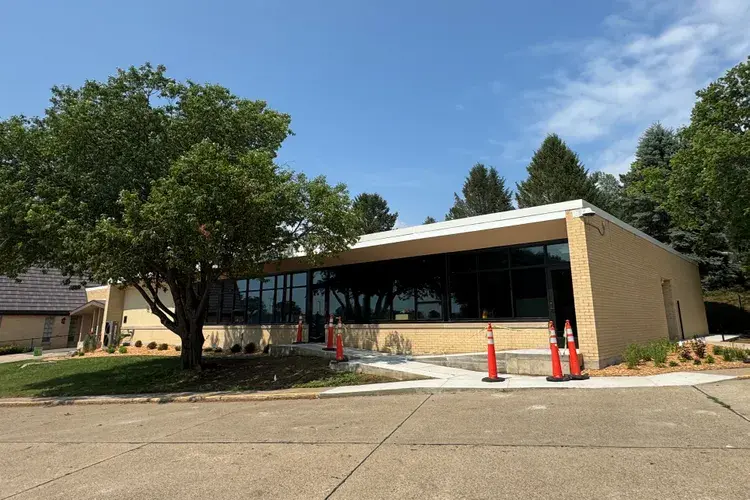
Instead, the committee searched Moville for a building that could be refurbished. “It just so happened that the Methodist church had a classroom wing that had not been used for a long time,” she said. The church supported the project by granting a long-term, low-cost lease to the Moville Area Childcare Center.
The committee set a goal to raise $1 million for renovations. A grant from the Missouri River Historical District got them halfway there. Woodbury County Farm Bureau donated $50,000. Local businesses and community members pitched in, and the goal was met after just a few months. Local workers began the renovation in the spring of 2026.
The center, which can care for up to 60 children, opened last month. “It feels very divine and aligned because of how quickly and easily it has fallen into place,” Nelson said. “The beautiful ecosystem that is our community worked together to make this project happen for kids and parents in our area.”
Renovating a building is one thing, but running a childcare center is another. Nelson said partnering with the Crittenton Center, a Sioux City nonprofit specializing in child and family development, took that task off their plate. Crittenton hired staff and manages the business. The group has partnered with the school to provide lunches.
“Crittenton has daycare centers across northwest Iowa, and they are a well-known, high-quality childcare organization,” Nelson said. “They know what they’re doing.”
Nelson said Moville plans to share its blueprint for success with other towns. “Nearby communities have said they’re watching us very closely because they want to do the same thing in their towns,” she said. “Teaching them how to replicate what we’ve done is a big part of our mission because we want all of our small towns to thrive.”