

How a Nebraska Landowner Used a 721 Exchange to Keep the Next Generation Farming

By Brooke Bouma Kohlsdorf, Contributing writer at American Farmland Owner, Published on September 9, 2026

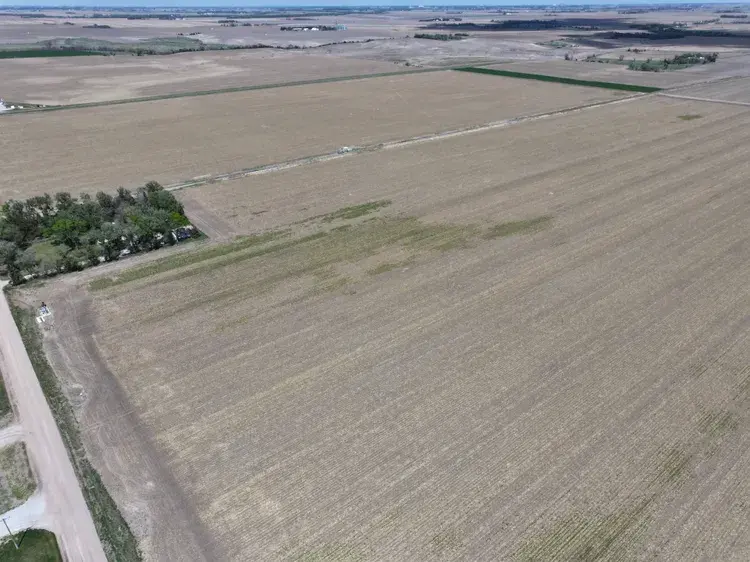
When Larry Consbruck retired from farming in 2014, he decided not to sell the 1,100 acres he owned and operated outside the south-central Nebraska towns of Juniata and Roseland. Instead, he leased the land to his nephew, a young farmer who wanted to farm but didn’t have land of his own to get started.
“It was always my goal to own land,” Consbruck said. “When I started buying it in the ’70s, the land could generate enough income to pay for itself. Today, it’s a lot harder because land is so expensive and farmers are barely making a profit.”
As the years passed, Consbruck began thinking about selling the farm. But he also wanted to ensure his nephew could continue farming the land.
“Knowing what the current farm economy is like, I knew it would be difficult for him to buy the farm,” Consbruck said. “When we started down this road, we started looking for investors. But we couldn’t find anyone willing to offer a long-term lease for my nephew.”
Helping a member of his family stay in farming was important to Consbruck. He also viewed it as a way to support the future of agriculture. “We really wanted to help keep the next generation farming,” he said.
That desire led him to consider an option he had never heard of before.
A Different Path Forward

When a Nebraska real estate agent contacted Consbruck about a relatively new approach to farmland ownership, he was intrigued.
The option was a 721 Exchange Trust. Rather than selling all of his land outright, Consbruck could exchange the property into a partnership and receive ownership shares in return.
Ethan Branscum of Sower Investment Partners in Omaha, Nebraska, helps landowners transition farmland into 721 Exchange structures.
While the concept has existed since the 1950s, Branscum said it has only recently begun gaining traction in agricultural real estate.
How a 721 Exchange Works
The name comes from Section 721 of the Internal Revenue Code.
“Per that section of the tax code, it allows people to exchange real estate into a partnership with no immediate tax implication,” Branscum said. “They contribute land into a partnership, and what they receive in return is ownership in that partnership.”
In practical terms, landowners no longer directly own the farm, but they retain ownership value through partnership shares. In Consbruck’s case, he was also able to negotiate a long-term lease arrangement for his nephew.
Branscum compares the structure to owning stock in a company.
“When they have ownership in our farmland fund, they’re not losing any value of their asset,” he said. “They retain that value, but now they have a lot of different options.”
Under the arrangement, the fund assumes management responsibilities and ownership costs.
“We take over management of the farm,” Branscum said. “We handle everything. The farmland fund owns the farm, so it handles all the expenses and responsibilities that come with land ownership.”
Benefits Beyond the Sale
Participants in the fund continue receiving income generated by the properties held within it.
“The person who contributed the land into the fund still receives distributions from the rental income of all the properties in the fund,” Branscum said.
The structure can also simplify estate planning.
“Land is hard to divide, and determining how to divide it equally can be difficult,” he said. “If you utilize this option, it’s a pretty clean way to divide assets later in life.”
Branscum added that contributing land to a fund partnership does not trigger an immediate capital gains tax event, which can be a significant advantage for landowners considering a sale.
A Solution for Farm Families
Lindsey Feuerborn, the Lashley Land and Recreational Brokers Realtor who handled the transaction, said she contacted Consbruck after learning about 721 Exchange funds earlier this year.
She believed the structure could be a good fit for his family’s goals.
“This is a fantastic option for families to pass down their land in a different way,” Feuerborn said.
Ultimately, Consbruck sold a portion of his land into the exchange trust, while another portion was purchased outright by Sower Investment Partners, which owns and manages the exchange fund. Sower offers both options to landowners.
Sales involving a 721 Exchange are negotiated privately, much like other real estate transactions.
Amy Lashley-Johnston, vice president and marketing director for Lashley Land and Recreational Brokers, said this was the company’s first transaction involving a 721 Exchange.
She doesn’t expect it to be the last.
“This is a ‘where have you been all my life?’ kind of solution,” she said.
Lashley-Johnston believes the structure helps landowners who want to sell their property while securing a long-term lease for family members who wish to continue farming it.
She said it can also help farmers who need liquidity for retirement, debt reduction, or other financial goals while remaining involved in the operation.
In addition, the structure may offer a solution when family members disagree about whether to keep or sell inherited land.
“As for me, the 721 checks a ton of boxes,” Lashley-Johnston said. “It saves us from a situation where a family goes to court and forces a sale. The land gets sold at auction, and that’s all there is to it. The siblings don’t speak again. It can tear a family apart permanently.”
Although the investment structure is still relatively new to many landowners, Lashley-Johnston said interest is growing.
“Now we’re lining them up like pool shots because people are hearing about it,” she said. “This is an answer to many people’s prayers that they just don’t know is out there.”
Looking Ahead
For Consbruck, the arrangement offered a solution that aligned with both his financial goals and his desire to support the next generation.
Because the concept was new to him, he spent considerable time researching the option, asking questions, and consulting with an attorney before moving forward.
Today, he said he would recommend others explore it as well.
“Do you want to keep the next generation farming?” Consbruck said. “If so, then yes, this is a good option.”
How the Sale Compared to Regional Land Values
The 1,106-acre property was listed for $12,422,100 or about $11,231 per acre. Fuerbron said the final selling price was close to the asking price.
For comparison, the University of Nebraska-Lincoln’s 2026 Nebraska Farm Real Estate Market Survey reported that center-pivot irrigated cropland in Nebraska’s south region averaged $8,490 per acre. The annual survey gathers input from land industry professionals across the state and found that Nebraska agricultural land values declined 1% during the past year to an average of $3,905 per acre statewide.
The Consbruck property was marketed at a significant premium to the regional average for irrigated cropland.
Land Sale Details
The property was marketed in four separate parcels.
Parcel 1
Acres: 210.06
Land details: 35% Class 1 soils, 30% Class 2 soils, and National Commodity Crop Productivity Index (NCCPI) rating of 66.8.
Irrigation:
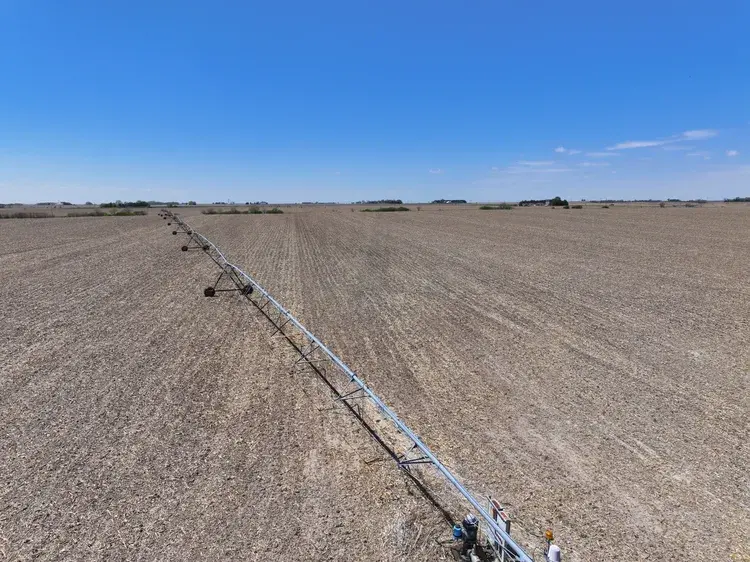
Seven-tower Reinke pivot purchased new in 2018. Well pulled and rebowled in 2018.
Four-tower Reinke pivot purchased in 2018 with a new submersible well.
Four-tower Reinke pivot and well installed in 2023, with subsurface irrigation added to 12.5 acres in 2024.
Parcel 2
Acres: 587.22
Land details: 44.9% Class 1 soils, 23% Class 2 soils, and NCCPI rating of 65.9.
Irrigation:
Seven-tower Reinke pivot installed in 2005. Well pulled and rebowled in 2005. Features a new sprinkler package and mostly new tires installed within the past two years.
Seven-tower T-L pivot installed in 2008. Well drilled in 1992.
Seven-tower Reinke pivot installed in 2024.
Remaining acres are subsurface irrigated.
Parcel 3
Acres: 156.65
Land details: 29% Class 1 soils, 43.8% Class 2 soils, 18.9% Class 3 soils, and NCCPI rating of 74.7.
Irrigation:
Seven-tower T-L pivot installed in 2003. Tires replaced in 2024. Well drilled in 2003.
Parcel 4
Acres: 152.81
Land details: 82.2% Class 1 soils, 15.2% Class 2 soils, and NCCPI rating of 67.4.
Irrigation
All subsurface irrigation installed in 2014.
Well pulled and rebowled in 2014.
Produced in partnership with American Farmland Owner (AFO). AFO aims to help landowners make informed decisions for their farmland while ensuring the prosperity of American agriculture.


